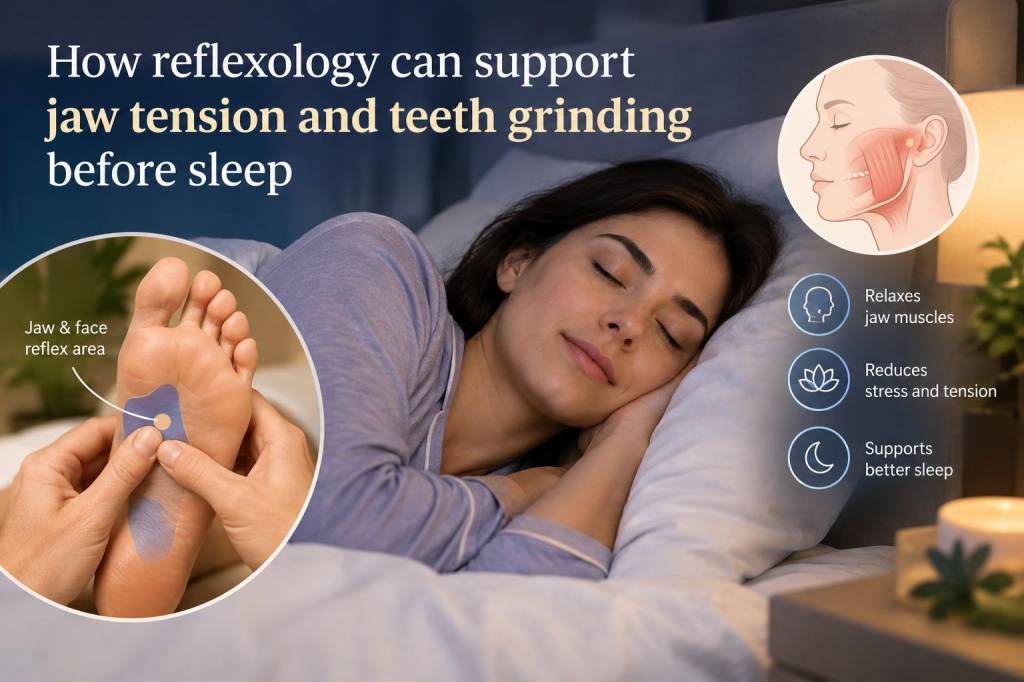
Many people notice that jaw tension feels worse at night. For some, it arrives as a tight, tired ache near the ears. For others, it shows up as clenching, grinding, or waking with a sore face and a dull headache. I often hear from people who say they only realise how much they hold in their jaw once they try to relax in bed. That moment, when sleep should feel restorative, can become a time when tension speaks up more clearly.
From my experience, reflexology can be a gentle and reassuring part of a nightly routine when jaw tension or teeth grinding feels linked to stress, overactivity, or a body that struggles to switch off. It is not a quick fix, and it is not a replacement for dental care, but it can support a calmer state before sleep and encourage a softer, more settled nervous system. When I work with someone who clenches at night, I look at more than just the jaw. I pay attention to stress load, breathing patterns, posture, digestion, sleep habits, and how easily their body can move from alertness into rest.
Why jaw tension often appears before sleep
Jaw tension can build quietly during the day. People may speak for long hours, hold concentration in their face, rush through meals, or sit with shoulders raised and breath held high in the chest. By evening, all of that effort can collect in the jaw. Once a person lies down, there are fewer distractions, so that tension becomes more noticeable.
Teeth grinding, or bruxism, may also be influenced by stress, sleep disruption, stimulants, or an overactive nervous system. I have seen that many people who grind at night are not aware of it until a partner mentions the sound, or a dentist notices signs of wear. Even when grinding has several causes, one common thread is a body that does not fully downshift into rest. That is where reflexology can be a useful supportive practice.
In a session, I often think about how the body stores alertness. Tightness in the jaw can sit alongside tension in the neck, shoulders, hands, diaphragm, and feet. If those areas are repeatedly asked to carry stress, sleep may arrive with effort rather than ease. Supporting overall relaxation can help create a better foundation for bedtime.
What reflexology may offer in this situation
Reflexology uses pressure on specific points of the feet to encourage relaxation and balance throughout the body. I do not approach it as a mechanical solution to jaw problems. Instead, I see it as a way to support the conditions that make ease more possible. When someone is tense, I want to help their whole system feel safer, slower, and more comfortable.
In practical terms, a reflexology session may help by:
Some people notice that when their whole body softens, their jaw follows. That does not happen instantly for everyone, but it is a pattern I have observed often enough to value it. When a person leaves a session feeling calmer, their bedtime habits may also become gentler, and that shift can matter.
What I focus on during a session
When someone comes to me with jaw tension or grinding concerns, I usually begin by asking about sleep, stress, work demands, posture, and any dental guidance they have already received. I also like to know whether they hold tension in their shoulders, whether they clench during focused tasks, and whether they notice discomfort when eating or speaking. Those details help shape a supportive session.
I often include reflex points linked with relaxation, the head, neck, spine, and digestive comfort, because these can all be relevant when a person is holding tension before sleep. I work slowly and with attention, aiming for a session that feels grounding rather than stimulating. Many people are surprised by how much relief they feel simply from having a calm space where nothing is demanded of them.
I also pay close attention to comfort. If someone feels tender, overwhelmed, or very sensitive, a lighter approach may be more helpful than strong pressure. Reflexology should feel supportive, not forceful. A good session invites the body to let go in its own time.
Simple evening habits that can support reflexology work
Reflexology can be even more useful when paired with small, realistic bedtime habits. I prefer routines that are easy to repeat, because consistency often matters more than intensity. A short ritual done regularly can have more impact than a long routine done once in a while.
Here are a few habits I often suggest alongside reflexology:
These habits are not dramatic, but they can help the body receive a clear signal: it is safe to slow down now. That signal matters when the jaw has learned to stay ready for action.
A simple self-care sequence for bedtime
When people ask what they can do at home, I often suggest a short sequence that takes only a few minutes. It is not intended to cure bruxism, but it can support relaxation before sleep and complement reflexology sessions.
Start by sitting somewhere quiet with both feet grounded. Notice whether your jaw is holding effort. Without forcing anything, soften the space between your teeth. Let your shoulders fall a little. Then spend a minute or two massaging the soles of your feet with your thumbs or fingers, using slow, steady pressure. Many people find it comforting to work through the arch of each foot, because that area often feels responsive when they are tense or overworked.
After that, rest a hand over your chest or abdomen and take several calm breaths. On each exhale, imagine the face becoming less busy. If you like, you can gently rub the ball of each foot and the heel area, moving at a pace that feels unhurried. A short self-massage like this can become a signal for sleep. If you do it most nights, your body may start to associate it with release.
When jaw tension needs extra attention
It is important to say that persistent jaw pain, locked jaw, significant headaches, tooth damage, or frequent grinding deserve professional attention. A dentist can check for dental wear, bite issues, or the possible need for a mouth guard. If stress is a major factor, a GP, physiotherapist, or other healthcare professional may also be useful. Reflexology can sit alongside that support, but it should not stand in its place when more specific care is needed.
I also encourage people to pay attention to patterns. If symptoms are worse during busy weeks, after poor sleep, or when life feels emotionally full, that information is useful. It can help you build a more realistic response rather than simply hoping the problem will disappear on its own.
What many people notice after a few sessions
People often tell me that they sleep more easily, wake less tightly, or notice that their jaw feels less braced after they have had time to relax properly. Others say they become more aware of clenching during day, which is a valuable shift in itself. Awareness allows a person to interrupt the habit earlier, instead of discovering it only after pain has built up.
I have also seen that when someone feels supported in a calm, regular way, they become more willing to care for themselves in small, sustainable actions. They may pause between tasks, breathe more fully, or take bedtime more seriously. Those changes matter because bruxism and jaw tension often live in a larger pattern of strain, not in one isolated place.
| Concern | What may help | Why it matters |
|---|---|---|
| Jaw tightness before sleep | Slow reflexology session, gentle breathing, warm compress | Encourages relaxation and softer muscle tone |
| Night grinding | Dental review, stress support, consistent bedtime routine | Addresses both physical protection and nervous system load |
| Waking with facial fatigue | Evening foot self-care, reduced stimulants, posture awareness | May reduce carry-over tension into sleep |
| Difficulty switching off | Quiet, repeated pre-sleep ritual | Helps body associate evening with rest |
What I value most about reflexology in this context is not only the physical touch, but also the message it sends: you do not have to stay braced all day and all night. A calm, steady routine can remind the body that it is allowed to soften. For many people, that message is exactly what is missing before sleep.