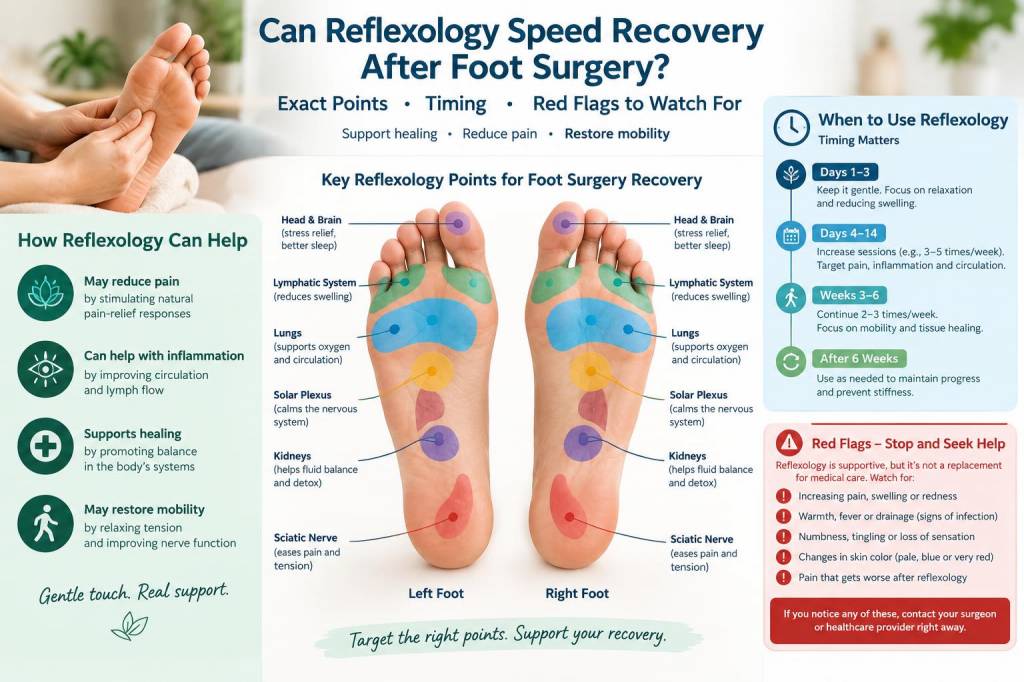
I often get asked in clinic and online: “Can reflexology speed recovery after foot surgery?” It’s a good question and one I approach with care. As a reflexologist, my aim is to support healing by reducing stress, encouraging good circulation and helping the nervous system settle — all of which can contribute to smoother recovery. That said, reflexology is complementary, not a replacement for surgical aftercare, physiotherapy or medical advice. Below I share practical points, exact reflex areas I commonly work with, suggested timing for sessions and the red flags that should prompt immediate medical review.
What reflexology can realistically offer after foot surgery
In my hands, reflexology focuses on calming the nervous system, improving wellbeing and encouraging lymphatic flow — factors that can indirectly support tissue repair and pain management. Practical benefits people often report include:
None of these guarantees faster wound healing, but they make recovery more comfortable and can help you engage better with physiotherapy and rehabilitation — which are direct drivers of a good outcome.
Exact reflex points I use (and how I adapt them post‑op)
When you’ve had foot surgery I avoid any direct pressure on the surgical site until it’s cleared by the surgeon. Instead I work strategically on linked reflex areas that support the foot and the healing process:
In practice I use gentle thumb‑walking, light circling and lymphatic pumping rather than deep pressure. For early sessions I avoid any technique that causes discomfort.
Timing: when to start and how often
Timing depends on the type of surgery (minor bunion correction vs. more complex reconstructions), your surgeon’s instructions and the presence of drains, casts, sutures or infection risk. These are general guidelines I follow and discuss with each client:
| Pre‑op | One or two sessions in the week before surgery can reduce anxiety, improve sleep and prepare breathing patterns — I often teach simple self‑care to take into the hospital. |
| Immediate post‑op (first 48–72 hours) | Avoid the surgical site. If cleared by the team, a short, very gentle session focusing on breathing/diaphragm reflexes, head/toe reflexes and contralateral foot work can help with rest and pain perception. |
| First two weeks | Work remains gentle: lymphatic strokes around the ankle, head/toe reflexes and spine reflexes. Frequency: 1 session per week, or shorter home routines 3–4 times/week. |
| Suture removal to 6 weeks | As stitches come out and swelling settles, sessions can increase in length and include more mid‑foot work, always under surgeon approval. This is a good time to coordinate with physiotherapy. |
| 6 weeks to 3 months | Progressive, more direct foot reflex work may be appropriate as bone and soft tissue strengthen. Sessions 1–2 weekly for active rehab support. |
| Beyond 3 months | Ongoing reflexology can support mobility, pain management and long‑term wellbeing. |
Practical at‑home routine I teach clients
When coming home from surgery, these gentle practices are easy to do between professional sessions:
Red flags: when to stop reflexology and seek medical care
Always stop complementary treatment and contact your surgeon/GP immediately if you notice any of the following:
If you’re ever uncertain, I advise clients to call their surgical team. It’s better to be cautious with post‑operative care.
Safety, professional liaison and useful products
I always ask clients to get written consent from their surgeon or physiotherapist before starting post‑operative reflexology. I also coordinate treatment with physiotherapists where possible so my sessions complement their rehab plans.
Useful products I often recommend for home care (check suitability with your surgeon):
Finally, if you have conditions like diabetes, peripheral neuropathy, active deep vein thrombosis, or you’re immunosuppressed, extra caution is needed — some of these are relative contraindications and require clearance from your medical team.
How I work with clients after foot surgery
My approach is collaborative and measured. I begin with a thorough intake covering the exact surgical procedure, current medications, wound status and the surgeon’s aftercare instructions. Early sessions are short and focused on relaxation, lymphatic support and sleep. As healing progresses, sessions become more tailored to mobility, pain management and return to activity goals. I use evidence‑informed techniques and always encourage you to continue prescribed exercises and follow medical advice.
If you’re considering reflexology after foot surgery and want to know what’s appropriate for your specific case, bring your surgical notes or discharge summary — I’ll be happy to review them and suggest a safe, personalised plan.