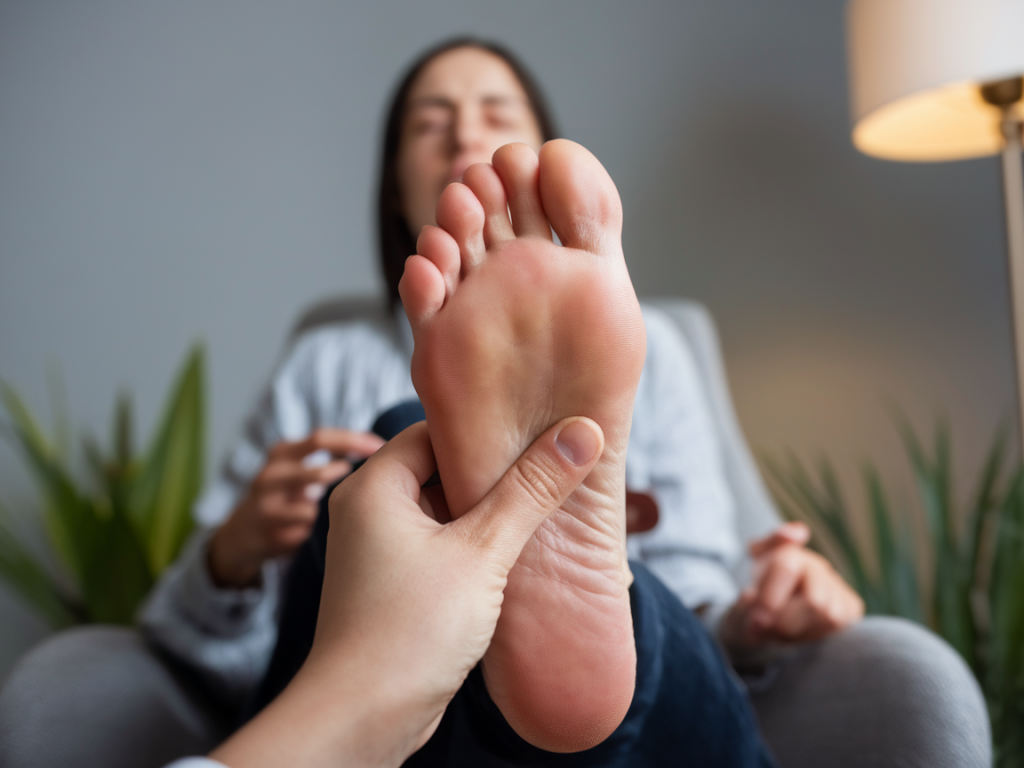
When someone tells me they’re in the middle of a panic attack, the first thing I want to offer is something simple and immediate they can do with their own hands. Over the years as a reflexologist and wellbeing practitioner I’ve found that pressing a few key reflex points—combined with calm breathing and grounding—can help reduce the intensity of a panic attack within minutes for many people. Below I describe three reflex points I often use in acute anxiety, exactly how to find and press them safely, and practical tips to make the technique effective. Please note: these techniques can help manage symptoms but are not a substitute for medical care. If you experience severe or frequent panic attacks, see a healthcare professional.
Why reflex points can help during a panic attack
Panic attacks trigger a strong sympathetic nervous system response—rapid heart rate, shallow breathing, dizziness and a surge of adrenaline. Reflexology works via gentle mechanical stimulation of areas of the feet (or hands) that correspond to the nervous system and the body's regulatory systems. In acute situations my aim is to activate calming pathways: slow the breath, encourage blood flow back to the core, and signal safety to the brain.
In practice I combine pressure on reflex points with two simple actions: slow diaphragmatic breathing and a grounding focus. The pressure itself gives a tactile anchor to focus attention, while the breathing and grounding reduce physiological arousal. When people ask “can this stop a panic attack in under five minutes?” I’m honest: it can significantly reduce intensity quickly for many people, but results vary. The technique is safest and most effective when practiced ahead of time so you know what to expect.
The three reflex points I use (and how to find them)
I typically use two points on the feet and one on the hand for immediate accessibility. You can do all points on the feet if you’re sitting or lying down, or use the hand point if you're standing or need to keep your shoes on.
- Solar Plexus reflex (foot): Located in the center of the sole, just below the ball of the foot—around the area where the diaphragm maps in reflexology. To find it, curl your fingers and press the pad under the base of your toes; the slightly softer, central pad is the solar plexus point.
- Adrenal/Glandular reflex (foot): Slightly behind the solar plexus, closer to the arch. This point corresponds with the adrenal glands and can help modulate the fight-or-flight surge. It’s a little firmer; you’ll feel a concentrated spot if you press with your thumb along the arch.
- Pericardium/Inner wrist point (hand): If you need a hand option, press the soft area between the tendons on the underside of the wrist—about two finger-widths down from the base of the palm. This is a common calming acupressure point (Neiguan / P6) and works well with reflex techniques.
Step-by-step: How to do it safely and effectively
When someone is panicking, clarity and simplicity matter. Follow these steps slowly and deliberately.
- Set your intention and slow the breath: Tell yourself “I’m going to try this for three minutes.” Inhale for 4 counts, hold 1–2 counts, exhale for 6–8 counts. Repeat while preparing to press points. If counting is hard, try ‘smell the flower, blow out the candle’ imagery.
- Position: Sit or lie down if possible. Remove shoes and socks if you’re using foot points. If you must stand, use the wrist point and one foot point if accessible.
- Apply pressure: Use the thumb pad (for feet) or index/middle finger (for wrist). Press firmly but not painfully—enough that you feel a clear pressure. Hold the pressure for 60–90 seconds on each point while continuing the breathing pattern.
- Sequence: Start with the Solar Plexus reflex (foot) for 60–90s, move to the Adrenal reflex (foot) for 60–90s, then press the Pericardium/wrist point for 60–90s. If you have only one hand free, switch feet after the first two points or repeat on the other side.
- Use gentle circular movement: If the hold feels tense, add a slow clockwise circular motion while maintaining pressure—this often deepens relaxation.
- Reassess and ground: After the sequence, keep slow breathing, name five things you can see, four you can touch, three you can hear, two you can smell, one you can taste (a simple grounding exercise). Re-assess your symptoms—if breath and heart rate have slowed you can repeat the sequence once more.
Safety notes, cautions and when to seek help
I always emphasise safety. Use these practices gently—avoid sharp, painful pressure. Stop if you feel dizzy, faint or experience sharp pain.
- If you have foot injuries, recent surgery, fractures or skin infections, avoid foot reflex pressure and use the wrist point instead.
- Pregnant people should consult a healthcare provider before using intense acupressure points; gentle pressure is usually fine but check first.
- If panic attacks are recurring or accompanied by chest pain, fainting, confusion or suicidal thoughts, seek immediate medical help.
- These techniques are complementary: they’re best used alongside therapy, medical care or prescribed medication when necessary.
Practical tips for making this work better over time
In my practice I teach people to rehearse the sequence when they’re calm so it becomes automatic during a crisis. A few small, practical ideas:
- Practice the three-point routine once daily for a week—60 seconds per point—so your hands know exactly where to go when you’re anxious.
- Use a small timer app (I like Insight Timer or the simple iPhone stopwatch) to train yourself to hold points for the recommended time.
- Carry a small sachet of lavender (or a drop of lavender essential oil on a tissue) if scent helps you relax—lavender has mild calming properties and pairs well with the tactile grounding.
- Consider combining this with other tools: grounding stones, a fidget object, or a guided breathing app (Calm, Headspace) if that helps redirect attention.
These reflex points are practical, portable and, when used with breath and grounding, can reduce panic intensity quickly for many people. I encourage you to try them gently, practise them ahead of time, and see how they fit into your personal toolkit. If you want a guided audio or a hands-on demonstration, I offer local workshops and 1:1 sessions in Southwest London where we practise these techniques together and adapt them to your needs.