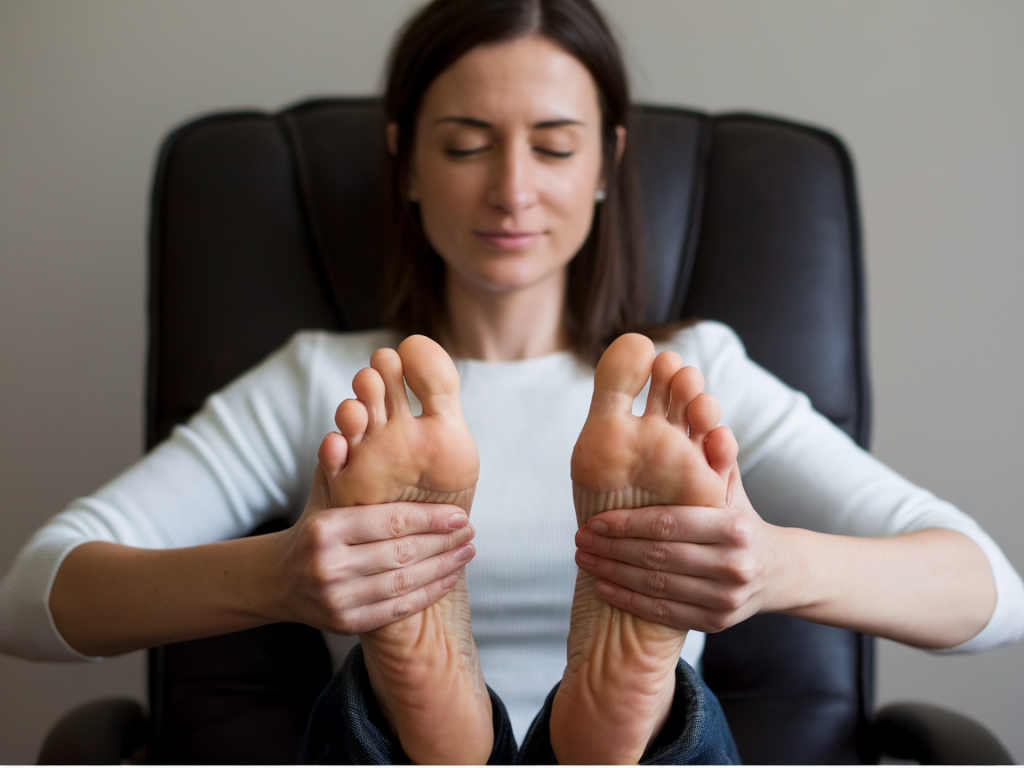
I often see clients who spend long days at a desk, chin tucked toward screens, shoulders hiking up during calls. Even a short sequence of mindful reflexology techniques can shift that habitual tension. Below I share a compact, office‑friendly reflexology routine you can do in about 7 minutes — no special equipment, no shoes, and discreet enough to perform seated at your desk or in a quiet meeting room. I’ve used these moves myself between back‑to‑back appointments and taught them in workshops across Southwest London; they work best when done slowly and with attention to breath.
Why reflexology for neck and shoulder tension?
Reflexology uses pressure points on the feet (and hands) to influence the nervous system and encourage release in corresponding body regions. I combine classical reflex techniques with mindful breathing so you don’t just work the tissues, you also down‑regulate the fight/flight response that keeps muscles tight. For desk workers, this approach is practical: the feet are easy to access while seated, the techniques are subtle, and they stimulate parasympathetic activity — the “rest and digest” state that helps muscles relax.
What you’ll need
Minimal kit. I recommend:
Everything here can also be done on your hands if shoes/socks make feet access impractical. The hand reflex points mirror many foot reflex zones, though the foot offers a slightly broader surface to work.
How to get the most from 7 minutes
Set a gentle intention: to release tension without forcing anything. Breathe slowly: inhale for 4 counts, exhale for 6 (or whatever feels natural). Use comfortable pressure — firm enough to feel but never painful. If you have diabetes, neuropathy, recent foot injuries, or circulatory conditions, check with a healthcare provider before trying pressure techniques on the feet.
7‑minute sequence (timings included)
Below is a practical timing breakdown you can follow. I recommend using the table as a quick reference until the sequence becomes familiar.
| Step | Action | Time |
|---|---|---|
| Warm up | Gentle foot rub and breath | 60s |
| Neck reflex zone | Thumb walk along the top of the big toe | 90s |
| Shoulder reflex zone | Thumb pressure on the area just below the base of toes toward the outer edge | 90s |
| Spine and upper back line | Thumb slide along the inner edge of the sole | 60s |
| Calming finish | Full foot hold and soothing strokes | 60s |
Total: ~7 minutes
Step‑by‑step details
Warm up (60 seconds): Sit comfortably with both feet flat. Rub your palms together briskly, then cup a foot and make slow, warming circles over the sole to increase circulation. Synchronise with slow breaths. The warmth and attention prepare the tissues and your nervous system.
Neck reflex zone (90 seconds): The neck is primarily represented on the tops and pads of the toes, especially the big toe. Use the pad of your thumb to perform a gentle thumb‑walk: press, release slightly, move forward a few millimetres, and repeat. Work across the top and around the base of the big toe for about 45 seconds per foot. Focus on even, calm pressure; encourage longer exhalations while you work.
Shoulder reflex zone (90 seconds): The shoulder reflexes sit around the outer edge of the ball of the foot, under the base of the little toe across to the base of the big toe. Using your thumb or knuckle, apply a firm, pulsing pressure along this band. Think of moving from the little toe side toward the big toe side in small thumb‑walks. Spend about 45 seconds per foot. If you feel a tender spot (a ‘reflex knot’), hold steady pressure for 5–10 seconds and breathe through it; this often produces a noticeable release.
Spine and upper back line (60 seconds): The inner edge of the sole (the side closest to the other foot) maps the spine. With your thumb or index finger, use a sliding motion from heel to just below the ball of the foot, slowing as you reach the area corresponding to the upper back. Repeat 3–4 times per foot. This mobilises the reflexive line that supports posture and upper‑back tension.
Calming finish (60 seconds): End by holding the whole foot in both hands. Place one hand under the heel and the other across the toes. Gently squeeze and then make long, soothing strokes from toes to heel. Finish with three deep, slow breaths, imagining tension draining away into the floor. This anchors the nervous system and makes the effects linger.
Quick hand alternative (if you can’t reach your feet)
Use the same zones on the hands. Thumb‑walk across the pads of the fingers for neck work, and along the outer edge of the palm for shoulder zones. The sequence translates well and is even easier to perform discreetly during calls.
When to avoid or adapt
How to integrate this into your workday
I suggest doing this sequence 1–3 times daily: mid‑morning, after lunch, and mid‑afternoon. Even a single 7‑minute practice before a long meeting can change how your body holds stress. Combine it with small ergonomic changes — monitor at eye level, shoulders relaxed, regular micro‑breaks for neck mobility — to get longer lasting results.
If you’d like guided audio to lead you through the sequence or a short video demo, Reflexology Southwest London Co hosts resources and occasional live sessions at https://www.reflexologysouthwestlondon.co.uk. I often run short lunchtime workshops where we practice these techniques together and tailor them to individual needs.